
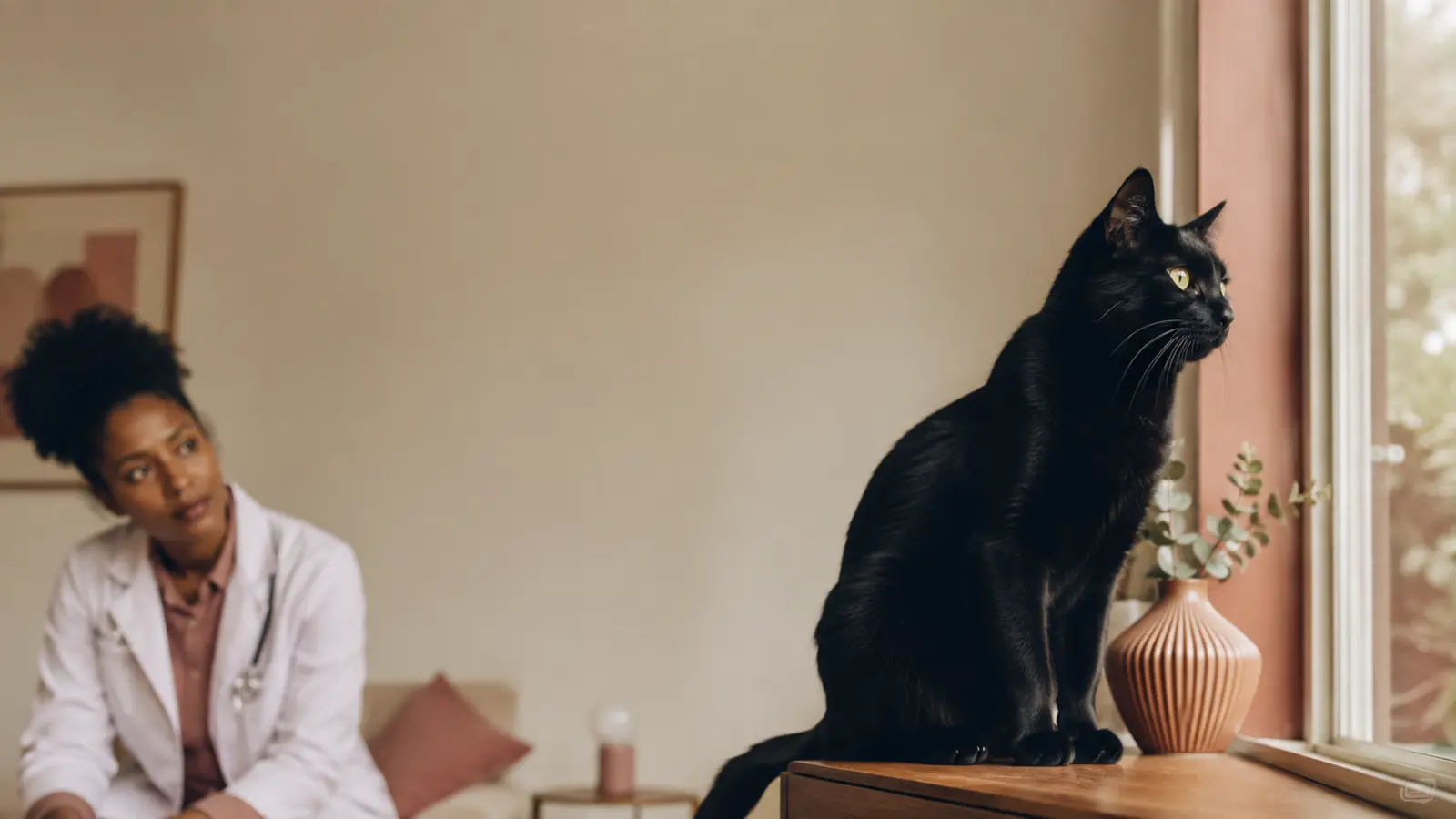
Some changes arrive slowly: a jump that begins to require hesitation, food left in the bowl, a coat that is less carefully groomed. Others reshape everyday life within days.
When a senior cat becomes unwell, families often face two questions at once: what is happening, and what should we do now? A diagnosis is an important part of the answer, but it does not describe on its own how that life is being lived.
We also need to understand how illness affects eating, mobility, rest, toileting, relationships and everything that still matters to that cat.
Ageing is not the same as illness
Ageing may alter pace, senses and needs, but age should not automatically explain weight loss, pain, vomiting, increased thirst, difficulty passing urine, disorientation or the loss of important routines.
Cats may show pain and illness subtly. The first sign is often a difference in the way they live.
- No longer reaching a favourite place
- Eating in stages or leaving the bowl
- Choosing unusual hiding places
- Tolerating less touch
- Grooming less
- Changes in sleep, vocalisation or litter tray use
Knowing how this cat usually lives
The most useful comparison is often between the cat today and themselves weeks or months ago. Ask what used to be easy, what now requires more effort and which activities remain spontaneous.
Dated notes, photographs and short videos can reveal trends that may not appear during a single consultation.
A diagnosis does not tell us everything
Two cats with the same diagnosis may have very different experiences. Disease stage, pain, nausea, other conditions, environment, temperament and treatment response all alter its impact.
Tests matter, but they must be interpreted alongside history, examination and daily life. Apparently stable results should not erase deterioration noticed at home.
Illness changes needs, not the value of a life
A cat who no longer jumps may still want the window. A cat who needs help to eat may still seek company. Limitation is not the absence of a meaningful life.
Care recognises what has changed without defining the cat only by what has been lost, and makes valued experiences more accessible.
Organising everyday care
For each medicine, diet, test or adaptation, understand its aim, expected timeframe, adverse effects, alternatives and review point.
Tell the team when medication causes a struggle, a prescribed diet is refused or costs have become unsustainable. An unworkable plan needs review. Never alter treatment without veterinary guidance.
Making the environment accessible
Wide low-entry litter trays, secure flooring, stable ramps, nearby resources, comfortable beds and predictable routines may reduce effort and restore choice.
Watch whether the cat uses each adaptation voluntarily. A solution that looks ideal on paper will not help if it is unstable, narrow or placed on a route they avoid.
Eating is more than offering food
Nausea, pain, constipation, dental disease, stress and medicines can alter appetite, smell, posture and the relationship with food.
Notice how much is actually eaten, whether the cat approaches and retreats, drools, swallows repeatedly, drops food or seems willing but unable to continue. Do not force-feed or improvise medication without guidance.
Medicines: the relationship matters too
When every encounter predicts restraint, safety and the bond may be affected. This does not mean abandoning needed care; it means looking for less aversive formulations, routines and handling with the team.
The best clinical plan must also be one that this cat can receive.
Follow response, not only completed tasks
After giving treatment, ask what changed for the cat. Choose visible indicators: eating with interest, resting, walking, using the tray or returning to an important interaction.
Record unwanted effects as well. Trends help determine whether a plan should continue, change or be replaced.
When the goals begin to change
The goal may be to treat a reversible cause, control chronic illness, preserve function or relieve suffering. These aims may coexist and change with the cat’s response.
Reviewing goals is not giving up. It is asking whether care still offers real benefit and remains coherent with that cat’s life.
Additional considerations
The family needs to understand the plan
It should be clear what is known, what matters now, what to observe, what is urgent and when the plan will be reviewed.
Caregiver reality belongs in care
Sleep, finances, work and emotional capacity influence feasibility. Naming limits allows priorities and adaptations.
The next step
When goals change, comfort and relief of suffering may move to the centre. That is not the absence of care, but a different direction for it.
Illness changes needs. It does not erase the dignity, individuality or value of that life.
Debee's perspective
Illness changes needs. It does not erase who they are.
Treatment matters. Relief matters. Adaptation matters. Continuing to recognise the cat beyond the diagnosis is also a profound form of care.
Glossary of terms
- Illness
- A process in which a health condition changes the body, behaviour, function or everyday experience.
- Goal of care
- The principal outcome guiding a plan, such as cure, control, preservation of function or relief of suffering.
- Trend
- A direction seen through repeated observations, more informative than one isolated event.
Sources and further reading
Educational content written by Debee Paulino, veterinarian and feline behaviour professional. It does not replace an individual veterinary assessment.
Back to the journal