
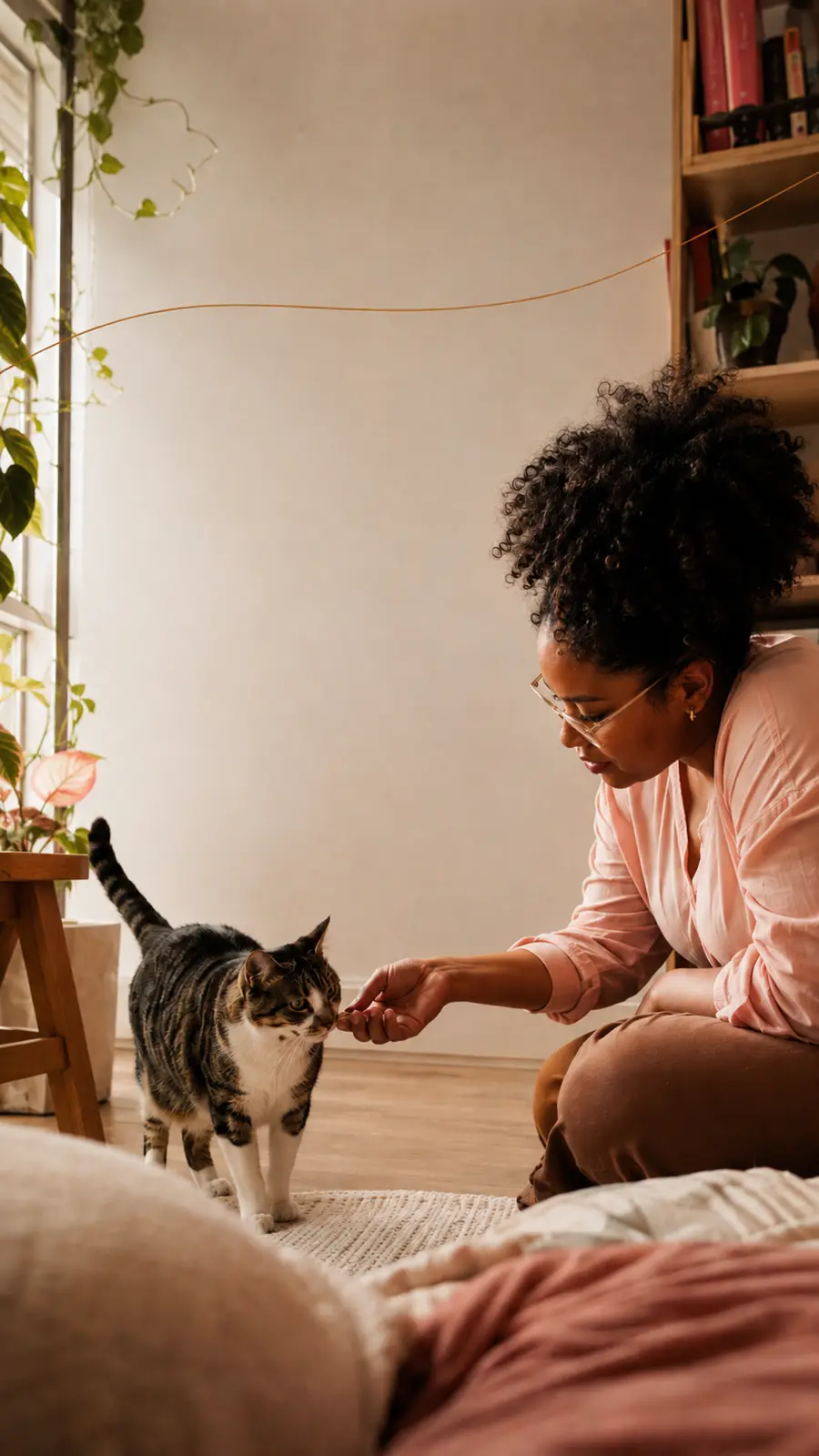
Caring for a senior cat does not mean removing everything that involves movement, curiosity or choice. It means noticing where daily life has begun to require too much effort and arranging the home so the cat can continue to participate in their own life.
Many difficulties first appear within ordinary journeys: climbing onto the bed, lowering the head to drink, crossing a slippery floor, reaching the litter tray at night or finding a peaceful place to eat. When every task asks a little more of the body, accumulated effort can reduce activity, independence and wellbeing.
A useful adaptation does not need to be expensive or make the home feel clinical. It should be safe, gradual and designed around the cat who lives there — their habits, preferences, relationships, limitations and retained abilities.
The question is no longer only ‘Can they still do it?’ It becomes: how much effort does it take — and how can we make that journey more comfortable?
Where should home adaptations begin?
Begin with the routes your cat travels every day. Watch how they leave their resting place, reach food, water and the litter tray, access favourite surfaces and move away when they want to be alone.
There is no need to change everything at once. Sudden alterations can create uncertainty, particularly for cats with sensory or cognitive changes. Prioritise pain, risk of falling, toileting, food, water and access to rest.
- Where the cat sleeps and how much effort it takes to get there
- Whether the floor provides secure grip
- High jumps or large gaps between surfaces
- Genuine access to food, water and litter trays
- Routes blocked by another animal
- Lighting during the night
- Activities that now take longer or have been abandoned
How should food and water be arranged?
A senior cat should be able to eat and drink in a safe, peaceful and physically comfortable place. Water in more than one location reduces travel and offers choice. Keep bowls away from litter trays and, where possible, separate from feeding areas.
Joint pain, weakness, oral disease, nausea and other conditions may change how a cat approaches food. Wide, shallow dishes can improve access. For some individuals, a small, stable elevation reduces discomfort; for others, it is unsuitable.
Do not change diet simply because of age. Nutritional needs vary, and food refusal, weight loss or changes in appetite require investigation.
How can the litter tray become more accessible?
The litter tray is essential and a common source of quiet difficulty. A cat may want to use it while experiencing pain when entering, balancing, squatting or travelling towards it.
Toileting outside the tray is not spite. It may reflect pain, urinary or gastrointestinal disease, mobility difficulty, insecurity, conflict, litter aversion or cognitive change. Environmental adaptation and veterinary assessment belong together.
- A low entrance and stable tray
- Enough room to enter, turn and choose position
- Firm, non-slip flooring around the tray
- A quiet, easy-to-reach location
- Trays in different areas and on each level
- A softly lit route at night
- Frequent cleaning and familiar litter
What supports mobility?
Accessibility is not about preventing movement. It allows a cat to move with less risk and discomfort.
Low steps, stable ramps or furniture arranged as stages can preserve access to beds, sofas, windows and other valued places. A steep or slippery ramp may be harder to use than small steps, so observe which solution the cat actually chooses.
Secure runners and non-slip mats can help on smooth floors. Ageing does not remove a cat’s need to observe from above: provide safe routes to valued heights alongside options at floor level.
How should rest, sleep and temperature be managed?
Senior cats may seek warmth and spend more time resting. Offer padded beds in quiet, dry places away from draughts while preserving choices of surface and proximity.
Heating products designed for animals should be used at low temperature with room for the cat to move away. Intense heat may cause burns. A soft night light may help along routes between the bed, water and litter tray.
When might a cat need grooming support?
Reduced grooming may occur when pain, stiffness, weakness, obesity, oral disease or illness makes self-care difficult. Before assuming a cat grooms less simply because they are old, investigate the cause.
Gentle brushing can remove loose hair, prevent matting and provide an opportunity to notice skin changes and sensitivity. Keep sessions short and pause when you see tension or withdrawal. Thick or curved claws, discharge, bad breath, mats and difficulty cleaning the hindquarters also deserve attention.
How can we interact without forcing?
Interaction remains important, but its form may change. Some cats seek more contact; others become sensitive to touch, tire more quickly or prefer to stay nearby without being handled.
Consent does not mean an absence of care. It means arranging care so the cat has predictability, participation and opportunities to say ‘not now’.
- Approach from the side and move predictably
- Speak softly before touching a cat with hearing or vision loss
- Allow the cat to approach
- Pause frequently
- Do not insist on being held, restrained or brushed
- Keep play brief and achievable
What changes in a multi-cat home?
Having several resources does not guarantee access when they are concentrated in one place. Two bowls side by side function as one station if a cat controls that area.
Distribute food, water, trays, resting places and scratching options, provide approach and escape routes, and watch for quiet blocking. A senior cat may stop confronting a situation they previously tolerated; sometimes they have simply stopped reaching what they need.
How can we tell whether adaptations are working?
An adaptation works when it improves access, is used voluntarily and does not create another risk. Change one or a few things at a time so that you can understand the effect.
When the clinical situation allows, observe whether the cat reaches valued places again, enters and leaves the litter tray more easily, slips less, eats and drinks comfortably, rests without interruption and shows renewed interest in an activity.
Additional considerations
Accessibility does not remove independence
Providing a step does not make a cat ‘forget’ how to jump. It allows them to choose the route that fits their body on that day.
Safety should not remove feline life
A safe home still offers exploration, observation, scent, play, scratching and social choice.
The best adaptation is individual
Not every cat accepts a fountain, ramp, soft bed or raised dish. Test options without immediately removing familiar resources. Preference is information too.
Possible care is better than perfect care
Begin with one important, sustainable change. Moving a tray closer, securing a rug or adding one stable step can transform a meaningful part of the day.
Adapting the home does not announce that a cat has lost their abilities. It recognises that they still have desires — and that the environment can help them reach what matters with less effort and greater dignity.
Debee's perspective
The home should not make a senior cat prove that they can still manage.
Adapting the environment recognises that they still have desires — and helps them reach what matters with less effort and greater dignity.
Glossary of terms
- Accessibility
- Arranging the environment to reduce barriers and allow safe access to important resources and activities.
- Consent in interaction
- Attending to a cat’s choices and signals during touch, handling or approach, allowing pauses and withdrawal whenever possible.
- Escape route
- A path that allows a cat to move away without becoming trapped.
- Grip
- The ability of a surface to support the paws without slipping.
- Resource
- Something a cat needs or values, including food, water, toileting, rest, hiding, height, scratching and interaction.
- Substrate
- The material placed inside a litter tray.
Sources and further reading
Educational content written by Debee Paulino, veterinarian and feline behaviour professional. It does not replace an individual veterinary assessment.
Back to the journal